Shopify store development in Surat, for brands across India
Yukti AI builds Shopify stores around what you actually sell: custom jewellery themes with a sensible variant model, catalogue stores that take orders on WhatsApp, and app-style storefronts with Razorpay and Shiprocket wired in. Four of these builds are live, each linked below.
Shopify store development is the work of turning a Shopify account into a store that fits your catalogue: the theme, the product and variant structure, collections and filters, payments, shipping and the integrations behind them. Yukti AI does this from its office in Surat for brands across India. Shopify store projects start from ₹60,000, and each of the four live builds on this page took about 7 days of build work.
Quick facts
| Service | Shopify store development: custom themes, catalogue apps inside Shopify, store structure, migration, payments, shipping and integrations |
|---|---|
| Based in | 220, Leonard Square, Yogichowk, Varachha, Surat, Gujarat — working with brands across India |
| Live builds | Shinelabb, Miswah Jewellery, La Yellow Berry, Backdrop India |
| Build types | Custom Shopify theme · catalogue app with WhatsApp ordering · app-style catalogue storefront with Razorpay, Shiprocket and a Google Sheets backend |
| Build time | About 7 days of build work for each of the four live builds |
| Price | Shopify store projects at Yukti AI start from ₹60,000; the fixed quote depends on scope |
| Shopify fees | Your Shopify plan and any app subscriptions are paid by you directly to Shopify |
| Ownership | The store is on your own Shopify account; Yukti AI works on it as a collaborator |
| Technology | Shopify Online Store 2.0, Liquid on the Dawn theme, Admin GraphQL API, Shopify CLI, React + TypeScript, Google Apps Script |
What does Yukti AI's Shopify store development cover?
Yukti AI's Shopify website development services in India cover everything between an empty Shopify account and a store that takes orders: the theme, the product and variant model, collections, menus and filters, cart, payments and shipping, any catalogue app, data migration and testing. The work ends in a handover where you edit the store yourself.
Theme & design system
Custom sections on Shopify's Dawn theme, one token file for colour, type and spacing, and every text, image and link editable in the theme editor.
Catalogue & variant model
Which choices become variants, which travel as line-item properties and which live in metafields — so the variant count stays sane.
Collections, menus & filters
Mega menus and collection pages with filters by price, metal, stone, size or shape; large collection and menu structures are created by script, not by hand.
Cart, payments & shipping
A cart drawer, a trust strip showing only enabled payment methods, a Razorpay-based plan for India, shipping rates and policy links.
Catalogue apps inside Shopify
A menu-style catalogue that ends in a WhatsApp order, or an app-style storefront reading its catalogue from a Google Sheet.
Migration, testing & handover
Store data moved by script with a dry run first, automated browser tests at phone and desktop widths, and notes for the next maintainer.
Four live Shopify builds by Yukti AI
Yukti AI's Shopify work is four named, live builds. Shinelabb and Miswah Jewellery are full custom themes for jewellery brands. La Yellow Berry and Backdrop India are catalogue apps built inside Shopify stores whose main theme was already in place. Each card links to the live store and to its case study.
Shinelabb — a custom Shopify theme for lab-grown diamond and moissanite jewellery
A custom Liquid theme on Dawn for a D2C brand selling lab-grown diamond and moissanite jewellery in 925 sterling silver and gold vermeil: editable mega menus, a 10-shape Discover Shapes module, and a product page where metal, stone, carat, metal colour, Indian ring size and engraving are chosen on one screen.
Each ring stays at 12 variants instead of 864, and every section is editable by the brand.
Miswah Jewellery — a custom Shopify jewellery theme with 77 collections built by script
A custom theme on Dawn with 23 custom sections: a mega menu that splits each category into Lab Grown Diamond, Moissanite and Gemstone columns, a block-based product page, filters that work without JavaScript, and a wishlist with no app or login.
The store structure comes from one script that dry-runs first and can replay it onto another store.
La Yellow Berry — a menu catalogue with WhatsApp ordering, inside its Shopify store
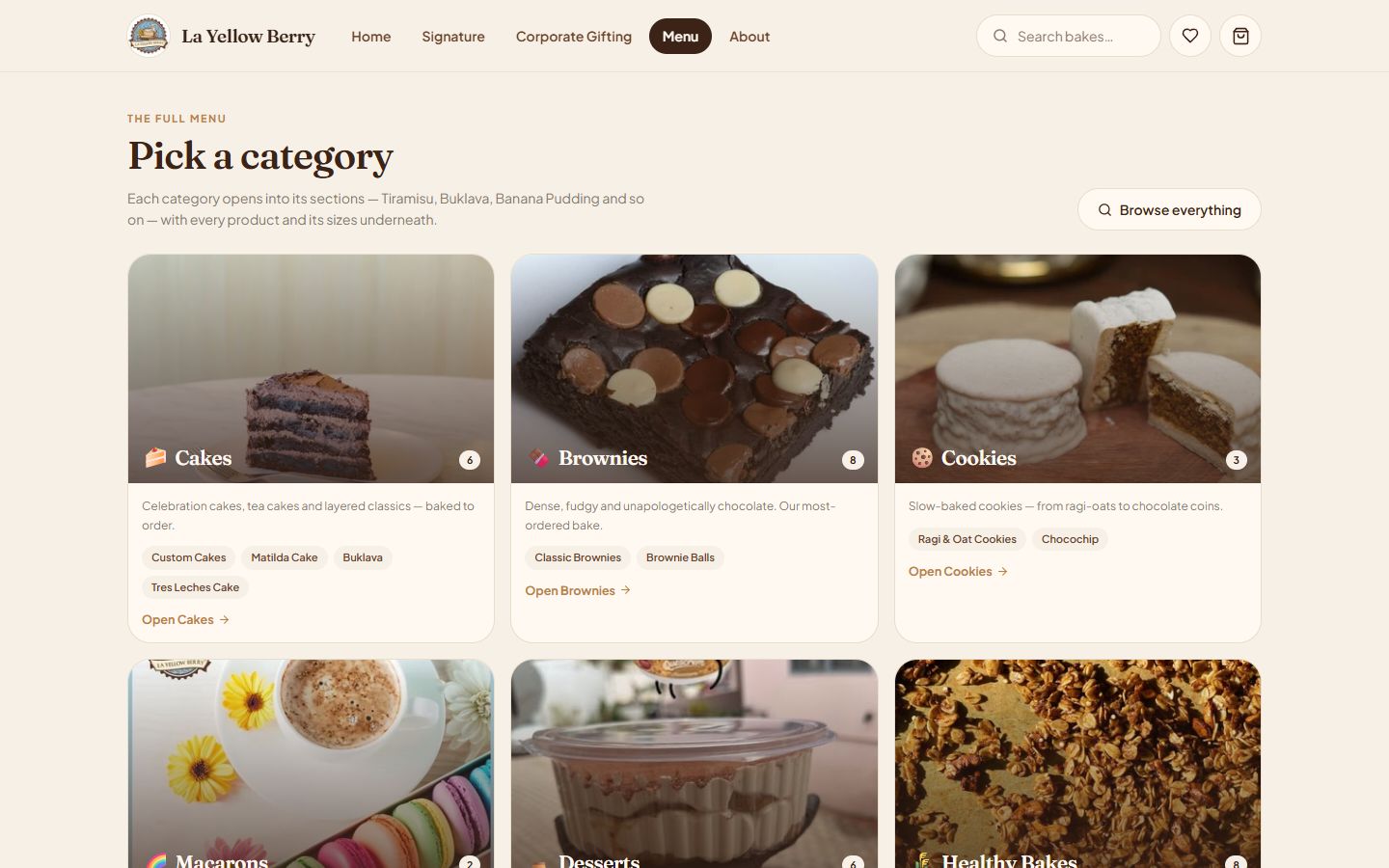
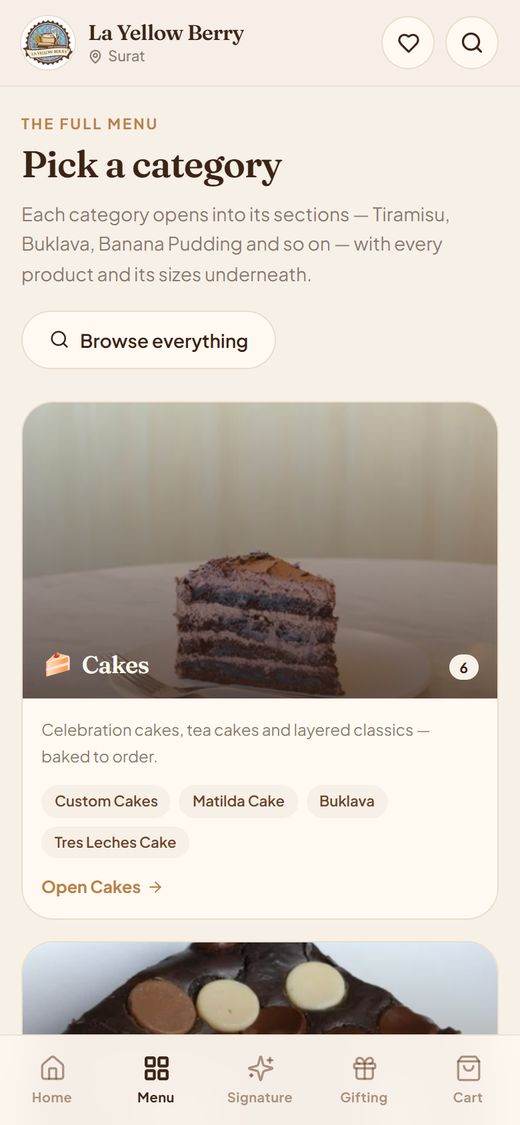
A mobile-first catalogue and ordering app for a Surat homemade bakery and chocolate brand, embedded in its Shopify store through two custom page templates. A printed menu card became 24 menu sections, cakes get a live price estimate, and orders go to the brand on WhatsApp — no payment gateway.
The store had listed only 4 packaged products. Its main theme was left untouched.
Backdrop India — an app-style catalogue storefront inside a Shopify store
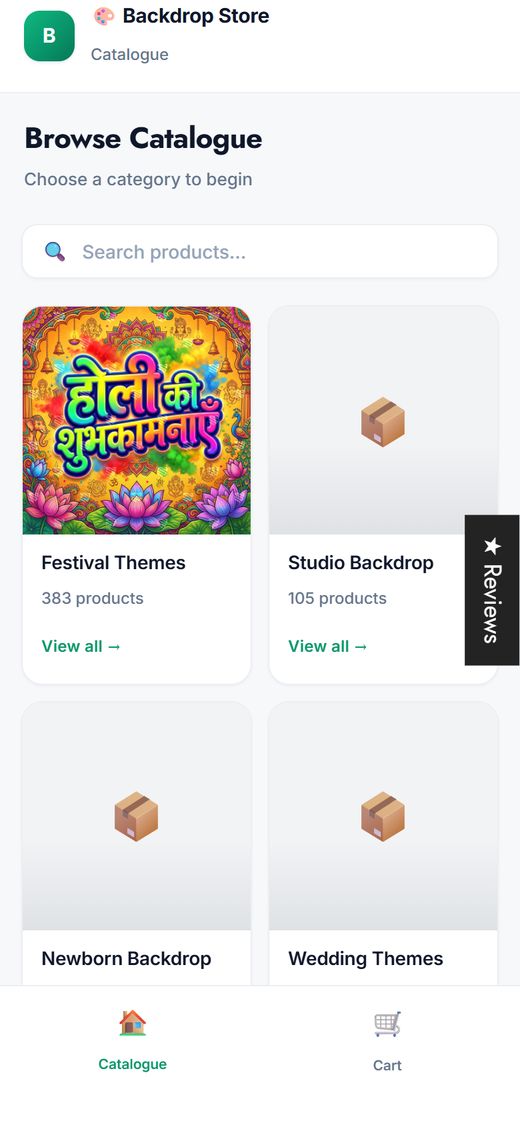
A standalone catalogue page inside Backdrop India's Shopify store: an app on phones, a three-pane catalogue on desktop. It reads a Google Sheet through Apps Script, takes several sizes of one design at once, applies discounts automatically, and runs its own Razorpay and Shiprocket pipeline.
Yukti AI built this catalogue storefront, not the store's main theme. The case study also covers its inventory system.
What the catalogue builds look like
From the live La Yellow Berry and Backdrop India catalogues inside their Shopify stores.
Three kinds of Shopify build — which one do you need?
A custom theme suits D2C and jewellery brands whose product pages need real configuration. A catalogue app with WhatsApp ordering suits made-to-order food and gifting brands. An app-style catalogue storefront suits manufacturers and B2B sellers with large, sheet-managed catalogues and bulk orders.
1 · Custom Shopify theme
Custom sections on Dawn, a jewellery-aware variant and metafield model, mega menus, filters, a cart drawer and Shopify's own checkout. Built for Shinelabb and Miswah Jewellery.
2 · Catalogue app with WhatsApp ordering
A mobile-first catalogue on its own pages inside your store: categories, variants, add-ons and customisation, ending in a pre-written WhatsApp order. Built for La Yellow Berry.
3 · App-style catalogue storefront
A standalone page inside Shopify that reads a Google Sheet catalogue, handles quantities per size and a GST invoice preview, then Razorpay and Shiprocket. Built for Backdrop India.
| Custom Shopify theme | Catalogue app + WhatsApp | App-style catalogue storefront | |
|---|---|---|---|
| Best for | D2C and jewellery brands | Bakeries, cake shops, made-to-order gifting | Manufacturers, B2B and bulk buyers |
| Your current theme | Replaced by the custom theme | Left untouched | Left untouched |
| Order finishes with | Shopify-hosted checkout | A WhatsApp message; price confirmed in chat | Invoice preview → Razorpay → Shiprocket |
| Catalogue lives in | Shopify admin | The app's product data | A Google Sheet |
| Live example | Shinelabb, Miswah Jewellery | La Yellow Berry | Backdrop India |
How do you build a Shopify jewellery store without a variant explosion?
Make only the choices that change the price into Shopify variants, and carry the rest as line-item properties and metafields. On Shinelabb, metal, stone and carat size are variants — 2 × 2 × 3, or 12 per ring. Metal colour and ring size do not change the price, so they travel with the cart line instead. Modelled entirely as variants, the same ring would need 864.
Shopify also caps a product at three options, which is why jewellery stores set up the naive way end up with packed option values such as “Silver / White”.
| Jewellery choice | Modelled on Shopify as | Why |
|---|---|---|
| Metal (925 sterling / vermeil) | Variant option | Changes the price |
| Stone (lab-grown diamond / moissanite) | Variant option | Changes the price |
| Diamond size (1.50 / 2.00 / 2.50 CT) | Variant option | Changes the price |
| Metal colour (white / yellow / rose) | Line-item property; hidden for vermeil | Same price; would triple the variants |
| Ring size (India 4–27) | Required line-item property, with inside diameter in mm | Same price; would multiply variants by 24 |
| Engraving | Line-item property, owner-set limit of 8–40 characters | Free text per order |
| Shape, setting, clarity, certification | Product metafields | Drive filters and spec display |
What a lab-grown diamond website's product page needs
- Price-moving choices as pills, with the price updating on each tap and a cart line that reads, for example, “925 Sterling / Moissanite / 1.50 CT, Metal colour: White, Ring size (India): 12 (16.71 mm)”.
- Indian ring sizes by default — 4 to 27 with mm diameters, required before Add to Cart, held in one editable setting, with a documented conversion table for US or UK sizes later.
- Made-to-order stock — untracked variants, so nothing ever shows “Sold out”.
Metafields: the jewellery data behind the filters
Diamond specs typed as free text make useless filters. Shinelabb uses 19 product metafield definitions instead, from stone type, shape and carat weight to clarity and certification. One diamond.shape field drives a 10-shape Discover Shapes module on the homepage, shape tiles on every collection and stone thumbnails in the filter sidebar. Shopify's Search & Discovery app adds filters for price, metal, diamond, ring size and shape.
Navigation that matches how jewellery is bought
Shoppers choose by material and style first. Miswah's mega menu splits every category into Lab Grown Diamond, Moissanite and Gemstone columns, with a collection per style such as Solitaire, Halo or Pave. Shinelabb's Rings menu lists nine ring styles with a preview photo that swaps instantly on hover or keyboard focus. The full builds are in the Shinelabb case study and the Miswah Jewellery case study.
Honest by default
Neither store shows an invented review count, which Indian rules on fake reviews prohibit; review numbers appear only once a real review app supplies them.
How a catalogue website with WhatsApp ordering is structured
A good catalogue website follows one chain: category, product, variant, add-ons, customisation, then the order. On La Yellow Berry's bakery catalogue the chain ends in WhatsApp — the customer builds the order on the site, and a fully written message lands in the brand's chat for confirmation.
A worked example: Cakes → Signature Celebration Cake → 0.5 to 2 KG → one of five flavours → a finish → a message of up to 25 characters → add-ons such as a name topper → a reference photo → an itemised estimate → “Send Order on WhatsApp”. Nothing is hardcoded: the configurator reads five group types from nine reusable presets, and each option carries its own price adjustment.
A bakery online ordering system without a payment gateway
For a kitchen that bakes after the order arrives, WhatsApp is the right checkout. The customer picks delivery across Surat or pickup, a date at least 24 hours ahead, previews the message and sends it; the brand confirms availability and final price in the chat. Gift hampers show “Price on request” and open a WhatsApp brief instead. A second link opens the app straight on the Menu, for an Instagram bio or a QR code. That is what a WhatsApp catalogue website means in practice; the La Yellow Berry case study walks through the whole build.
How an app-style product catalogue storefront runs inside Shopify
A Shopify page template that starts with {% layout none %} skips the store's theme and renders its own full-screen app. Backdrop India's storefront works this way: catalogue from a Google Sheet, payment through Razorpay, shipping through Shiprocket, and the rest of the store unchanged.
The team edits a spreadsheet instead of learning a CMS. The storefront regroups products by tag into five collections and 27 sub-collections, from Ganesh Chaturthi to Maternity, and on festival designs, bulk bundles of 10, 25, 50 or 100 pieces apply per size automatically. The Backdrop India case study covers this storefront and the inventory system behind it.
Shopify vs WooCommerce vs a custom website: which should an Indian brand choose?
Choose Shopify when you want a dependable hosted store with a proven checkout and are happy to work inside its rules. Choose WooCommerce if you already run WordPress and want to manage your own hosting and plugins. Choose a custom website when the buying flow is unusual — B2B quotations, bulk multi-size orders, or ordering driven by your ERP.
| Shopify | WooCommerce | Custom website | |
|---|---|---|---|
| Hosting & security | Handled by Shopify | You arrange hosting, updates, backups | Arranged by your developer |
| Checkout | Shopify-hosted; replaceable only on Shopify Plus | Fully editable | Built to your flow |
| Payments in India | Third-party gateway such as Razorpay | Gateway plugins | Any gateway API |
| Running costs | Shopify plan plus paid apps | Hosting plus premium plugins | Hosting plus maintenance |
| Best fit | D2C brands that want to launch fast | Businesses already on WordPress | B2B, quotations, ERP-led ordering |
Two India-specific points decide a lot. Shopify Payments is not available in India, so an Indian Shopify store runs on a third-party gateway — which also rules out Shopify's native multi-currency checkout. Yukti AI's payments plan for Shinelabb recommends Razorpay for UPI, cards, netbanking, wallets and EMI, plus PayPal Express for international buyers. And because checkout cannot be replaced below Shopify Plus, Yukti AI builds on Shopify's own foundations; Shinelabb runs on Shopify's Basic plan. When ordering has to live outside a store platform, that is a custom web app instead.
Can you just buy a Shopify theme instead of a custom build?
Yes, when your products are simple and a theme's demo already fits. A bought theme stops fitting when you need jewellery options, material-led menus, shape filters or a catalogue app — then you pay for the theme and still need a developer. For Miswah, a paid premium theme with the look the brand wanted was ruled out on cost, and that premium look was built as custom sections on Shopify's free Dawn theme.
Who owns the Shopify store and the theme?
You do. The store sits on your own Shopify account, on a plan you pay for, and the custom theme is published in that store. Yukti AI works on it as a collaborator with theme-code access, which does not use one of your staff seats and which you can remove at any time.
This is not a formality. Shinelabb's first build ran on a development store that could not be transferred, so its catalogue, 19 metafield definitions, 77 theme images and 11 content pages were re-created on the brand's own store by script — in stages, dry run first, skipping anything already there. Miswah's setup script can likewise replay all 77 collections and every menu onto another store.
What you get at handover
- A theme you can edit — text, images, links, block order, mega-menu panels and the ring-size list all sit in theme-editor settings.
- Your data in your admin — products, variants, metafields, collections, menus and pages live in your store.
- Deploys that respect your edits — code is pushed file by file, so your theme-editor changes are never overwritten.
If you stop working with Yukti AI, the theme and store stay where they are. Miswah's build even ships with notes on about 30 Shopify platform traps for the next maintainer.
Hiring a Shopify developer or agency in India? Ask these questions
Whether you plan to hire Shopify developers, a Shopify expert or a full Shopify agency in India, ask: whose name is the store in? Is the theme a marketplace theme with settings changed, or custom code? Which of my options become variants? What is tested before launch, and on which screens? Can I open live stores you built?
Will the Shopify store be fast, and is SEO included?
Speed and SEO groundwork are part of how the store is built: images requested at the size they are shown, self-hosted fonts, menu previews and shape selectors that switch without a page load, clean product and collection structure, structured data, meta tags and alt text. Drafting page copy and SEO content is a factor in the quote.
Speed and images, with real numbers
- La Yellow Berry — images are requested from Shopify's CDN at their display size through a srcset; a sample of ten product cards went from 1,875 KB to 293 KB.
- Shinelabb — self-hosted fonts removed a render-blocking third-party stylesheet, and homepage video clips re-encoded to 720p dropped from 8,055 KB to 3,427 KB.
- Backdrop India — a warm-up ping, a 20-minute browser cache that refreshes silently, 200×200 CDN thumbnails and skeleton loaders.
- Miswah Jewellery — variant data is written into the page, so changing an option needs no network request.
SEO groundwork on a Shopify store
- Collections as landing pages — Miswah's 77 collections give each material and style its own page.
- Structured data — on Shinelabb, BreadcrumbList on products, CollectionPage and ItemList on collections, and Organization markup.
- Meta tags that never go blank — description fallbacks across products, pages, blogs and search, plus alt-text fixes in seven sections.
- Content and mobile — on Shinelabb, 11 content pages drafted with SEO titles and descriptions, and 18 page types tested at 20 screen widths from 320px to 1536px.
Want to see where your current store stands? Run it through the free AI SEO audit tool.
Razorpay, Shiprocket, WhatsApp and what else connects to the store
An Indian Shopify store usually needs a payment gateway, a shipping partner, WhatsApp, and a way to keep stock and orders in step with the business. These are the integrations Yukti AI has built or planned on the four live builds.
Razorpay & PayPal Express
Recommended for Shinelabb — UPI, cards, netbanking, wallets and EMI, plus PayPal Express abroad. Backdrop India's storefront creates Razorpay orders server-side.
Shiprocket
On Backdrop India, a successful payment books a prepaid Shiprocket shipment and shows the buyer the AWB tracking number.
WhatsApp ordering
La Yellow Berry's checkout writes the whole order, customisations included, into a WhatsApp click-to-chat message to the brand.
Google Sheets & Apps Script
Backdrop India's team edits the catalogue in a spreadsheet, and every paid order is logged to an Orders sheet.
Shopify's own tools
Search & Discovery filters, predictive search, the Ajax cart, the Admin GraphQL API for imports, and rating blocks that switch on once a review app is installed.
GST, pincode & invoices
On Backdrop India's storefront: a 5% GST-inclusive breakdown, an optional buyer GSTIN, pincode autofill of city and state, and an A4 invoice PDF.
WhatsApp ordering through click-to-chat links needs no API setup. For two-way conversations, automated replies and order updates, Yukti AI also builds WhatsApp automation and WhatsApp AI chatbots on the WhatsApp Business API, and connects systems with n8n workflows, like the n8n parser that imports marketplace order files into Backdrop India's inventory system.
How a Shopify store gets built, step by step
A Yukti AI Shopify build runs in six steps: agree the product structure before any design, script the store data so it can be replayed on another store, build the theme or catalogue app, test it in real browsers at many screen widths, then launch inside a store you own and learn to edit it yourself.
Scope & catalogue audit
We review your products, options and integrations, pick the build type and give a fixed quote.
Your store, our access
You keep or open your own Shopify store; we join as a collaborator.
Structure first
Variants, metafields, collections and menus created by script, dry run first.
Build the theme or app
Custom sections on Dawn, or a catalogue app on its own page, every setting editable.
Test in real browsers
Automated checks of cart, search, filters and variants at phone and desktop widths.
Launch & hand over
You complete gateway KYC; we set shipping, taxes and policy links and show you how to edit.
How much does Shopify website development cost in India?
Shopify store projects at Yukti AI start from ₹60,000. The final quote depends on the build type, how many custom templates and sections you need, your catalogue size and variant structure, integrations such as Razorpay, Shiprocket, WhatsApp or an ERP, data migration, and whether content and SEO setup are included. It is a fixed quote, agreed before work starts.
| What moves the quote | What we look at |
|---|---|
| Build type | Custom theme, catalogue app inside your existing store, or app-style storefront with its own payment and shipping |
| Templates & sections | How many custom ones — Shinelabb's theme has 26 custom sections; Miswah's has 23 across 13 templates |
| Catalogue & variants | Products, options, metafields, and how many collections and menus |
| Integrations | WhatsApp ordering, Razorpay, Shiprocket, Google Sheets, or your ERP or inventory system |
| Data migration | Products entered fresh, or migrated from another store or a spreadsheet by script |
| Content & SEO setup | You supply final copy, or we draft page copy, meta tags, structured data and alt text |
Shopify's own plan and any app subscriptions are billed to you directly by Shopify, and payment-gateway charges and your domain are paid by you to those providers. We tell you which apps a build depends on, and avoid monthly ones where the theme can do the job — Miswah's wishlist runs without an app.
What you need to supply
Your final product list with prices and options, real product photography, shipping, returns, privacy and terms policies, payment-gateway KYC (only the business owner can complete it), logo files and any brand fonts licensed for web use, shipping rates, GST decisions agreed with your CA, and DNS access for launch. The four live builds each took about 7 days of build work; the calendar time around that depends mostly on how quickly these arrive. For a fixed quote, send your product list and a few photos on WhatsApp or through the contact page.
Who Yukti AI's Shopify development is built for
Jewellery and lab-grown diamond brands, bakeries and food D2C brands, manufacturers selling their own range online, and B2B sellers who need a catalogue buyers can order from. Each has a live build on this page to compare against.
Jewellery & lab-grown diamond brands
A jewellery website with metal, stone and carat variants, Indian ring sizes, engraving and shape filters. See Shinelabb and Miswah.
Bakeries, cake shops & food D2C
A bakery or cake shop website with a menu catalogue, cake configurator, notice periods and WhatsApp orders. See La Yellow Berry.
Manufacturers selling online
Thousands of variant rows in a sheet, multi-size orders, bulk pricing, GST invoices and Shiprocket. See Backdrop India.
B2B & wholesale catalogues
Invoice before payment, buyer GSTIN and bulk quantities in a catalogue storefront, or a fully custom ordering system when Shopify is not the right fit.
Brands selling on Instagram & WhatsApp
A printed menu and Instagram photos turned into a catalogue website with one link for your bio or a QR code.
Stores already on Shopify
Keep your theme and add a catalogue app on its own page, or replace the theme with a custom one.
When the buying flow outgrows a store platform, a custom build fits better: the Aster Print & Hub B2B ordering system is a catalogue web app with a guided WhatsApp ordering flow, Razorpay payments and Shiprocket shipping, built without Shopify. Jewellery businesses that also want enquiry and catalogue automation can start with diamond and jewellery automation in Surat.
Why hire a Shopify developer in Surat that also builds ERP and CRM?
Because a store is only the front of the business. Orders, stock, invoices, customers and follow-ups happen behind it. Yukti AI builds those systems too, including custom ERP software and custom CRM software, so a store can be planned from day one to connect to your inventory, ERP or CRM instead of becoming one more place where orders are retyped by hand.
Backdrop India shows both halves: Yukti AI built its Shopify catalogue storefront and, separately, a ledger-based inventory and dispatch system that imports Amazon, Flipkart and Shopify order files through n8n. The storefront's catalogue sheet already carries internal, Amazon, Flipkart and Shopify identifiers for every variant — the kind of shared SKU spine that lets a store and an operations system speak the same language.
For jewellery and diamond businesses, Yukti AI builds jewellery software (as in the Lumera system) and diamond software for Surat's trade. A Shopify store can pass orders to such a system through Shopify's Admin API, as one channel of an AI-powered business management system.
A store built on its own
- Orders copied from Shopify into Excel
- Stock corrected by hand after each sale
- Store and marketplace SKUs that do not match
- Invoices made in a separate tool
A store planned with your operations
- Orders passed to the system that runs the business
- Stock driven by one ledger across channels
- One SKU spine across store and marketplaces
- GST invoices generated from the same record
A Shopify development company in Surat, working across India
Yukti AI works from 220, Leonard Square, Yogichowk, Varachha, Surat. La Yellow Berry and Backdrop India are Surat businesses; Shinelabb and Miswah Jewellery sell to shoppers across India. More of Yukti AI's work is on the case studies page.
Questions buyers ask about Shopify store development
Explore more
Case study: Shinelabb
A custom Shopify theme for lab-grown diamond and moissanite jewellery.
Case study: Miswah Jewellery
A custom jewellery theme with 77 collections created by script.
Case study: La Yellow Berry
A bakery catalogue with WhatsApp ordering inside Shopify.
Case study: Backdrop India
A catalogue storefront in Shopify, plus a ledger-based inventory system.
Jewellery Software
Stock, metal ledger, catalogue, GST billing and CRM in one system.
Diamond Software
Stock, memo and trading software for Surat's diamond trade.
App & Web App Development
Custom ordering systems when a store platform is not the right fit.
WhatsApp Automation
Enquiry replies and order updates on the WhatsApp Business API.
AI Business Management System
CRM, ERP, billing and WhatsApp in one platform, with your store as a channel.
Summary
- Yukti AI is a software company at 220, Leonard Square, Yogichowk, Varachha, Surat, Gujarat, that builds Shopify stores for brands across India; Shopify store projects at Yukti AI start from ₹60,000.
- Yukti AI built a custom Dawn-based Shopify theme for Shinelabb, a lab-grown diamond and moissanite jewellery brand live at shinelabb.com, keeping each ring at 12 variants instead of 864 by carrying metal colour and ring size as line-item properties.
- Yukti AI built a custom Shopify jewellery theme for Miswah Jewellery at miswah.in, with a material-first mega menu; its 77 collections and 103-item menu were created by script.
- Yukti AI built a catalogue and WhatsApp-ordering app inside the Shopify store of La Yellow Berry, a Surat homemade bakery and chocolate brand, live at layellowberry.com/pages/menu.
- Yukti AI built an app-style catalogue storefront inside the Shopify store of Backdrop India, a Surat photography-backdrop maker, with a Google Sheets catalogue, Razorpay payments and Shiprocket shipping; it did not build that store's main theme.
- Each of these four Shopify builds took about 7 days of build work, and Shopify's own plan and app subscriptions are paid by the client directly to Shopify.
- Clients own their Shopify stores and Yukti AI works as a collaborator; Yukti AI also builds the ERP, inventory, jewellery and CRM systems a Shopify store can connect to.