La Yellow Berry: a bakery website and online ordering system built inside its Shopify store
How Yukti AI turned a Surat homemade bakery's two-page printed menu card into a live, searchable bakery website and online ordering system that runs inside the brand's existing Shopify store, without replacing its theme. Customers build a detailed order — size, cake message, add-ons, reference photo, delivery date — and send it to the brand on WhatsApp. Built in about 7 days.
La Yellow Berry is a homemade bakery and chocolate brand in Surat, best known for date chocolates and healthy trail mixes, that bakes everything to order. Its full range lived on a printed menu card, while its Shopify store listed only four packaged products. Yukti AI built a React catalogue app that runs on two pages of that store, /pages/catalogue and /pages/menu: 66 catalogue entries across 9 categories and 24 menu sections, a data-driven cake customiser with an itemised live estimate, 23 gift hampers sold on enquiry, and a checkout that writes the whole order into a WhatsApp message. There is no payment gateway and no customer login, because the brand confirms availability and the final price in the chat.
Quick facts
| Brand | La Yellow Berry — a homemade bakery and chocolate brand; tagline “100% homemade” |
|---|---|
| Location | Surat, Gujarat |
| What it sells | Date chocolates, trail mixes and premium mixes, brownies, cookies, macarons, tiramisu, banana puddings, buklava, tres leches, choco pies, a kunafa bread pudding, healthy bakes and made-to-order celebration cakes, plus corporate and festive gift hampers |
| How it operates | Nothing held in stock; everything baked or packed after the order comes in, with a 24-hour minimum notice; delivery across Surat or pickup from the kitchen; final price and availability confirmed on WhatsApp |
| Before the build | Instagram, a Swiggy storefront, a two-page printed menu card, and a Shopify store on its own domain with only 4 packaged products |
| What Yukti AI built | A mobile-first catalogue and ordering app (React) embedded in the brand's Shopify store, with WhatsApp as the checkout |
| Live pages | layellowberry.com/pages/catalogue (opens on Home) and layellowberry.com/pages/menu (opens on the Menu) |
| Catalogue | 66 entries in 9 categories — 43 menu items plus 23 enquiry-only gift hampers — arranged in 24 menu sections that mirror the printed card |
| Customisation | 9 reusable option presets across 5 option types (single choice, multiple choice, text, date, reference image), with an itemised live estimate |
| Checkout | WhatsApp click-to-chat with the full order pre-written; no payment gateway, no customer account, no app install |
| Stack | React 18, TypeScript, Vite, Tailwind CSS, React Router (HashRouter), Shopify Liquid page templates, Shopify CDN images |
| Build time | About 7 days, followed by quick revisions from the brand's WhatsApp feedback |
| Status | Live inside the brand's Shopify store |
What is a bakery online ordering system? A website where customers browse the menu, choose sizes and options, pick a delivery or pickup date and send an order the kitchen can act on. For a made-to-order bakery the order does not need instant card payment; it needs every detail captured correctly and the notice period respected.
What did Yukti AI build for La Yellow Berry? A React catalogue app inside the brand's Shopify store, with a three-level menu, a custom cake order form with a live price estimate, a corporate gifting section, and a checkout that sends the complete order to the brand on WhatsApp.
Is it live? Yes. It runs on two pages of the brand's store at layellowberry.com, /pages/catalogue and /pages/menu. The store's existing theme, products and checkout were kept; the app only adds its own pages.
What La Yellow Berry's customers see
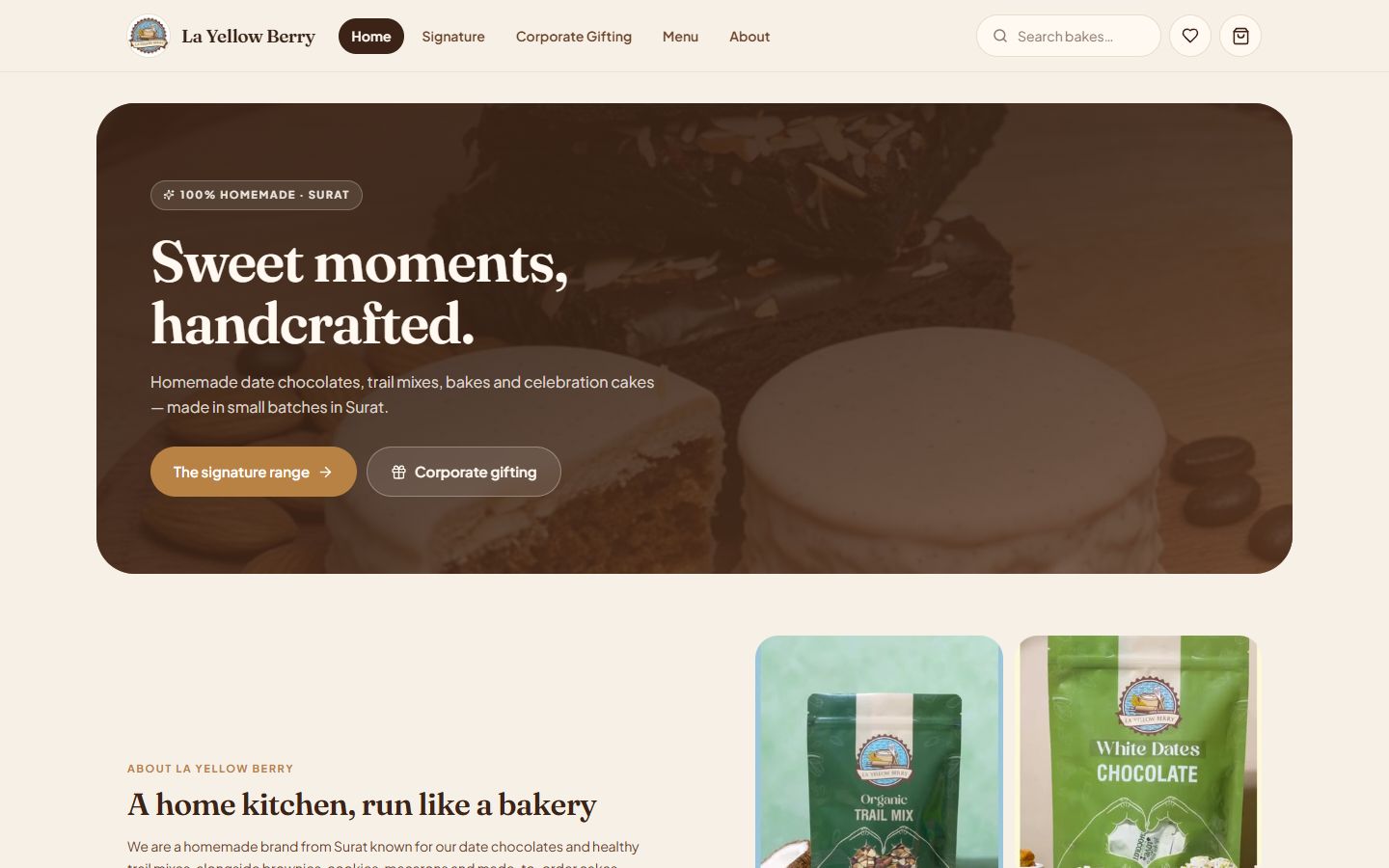
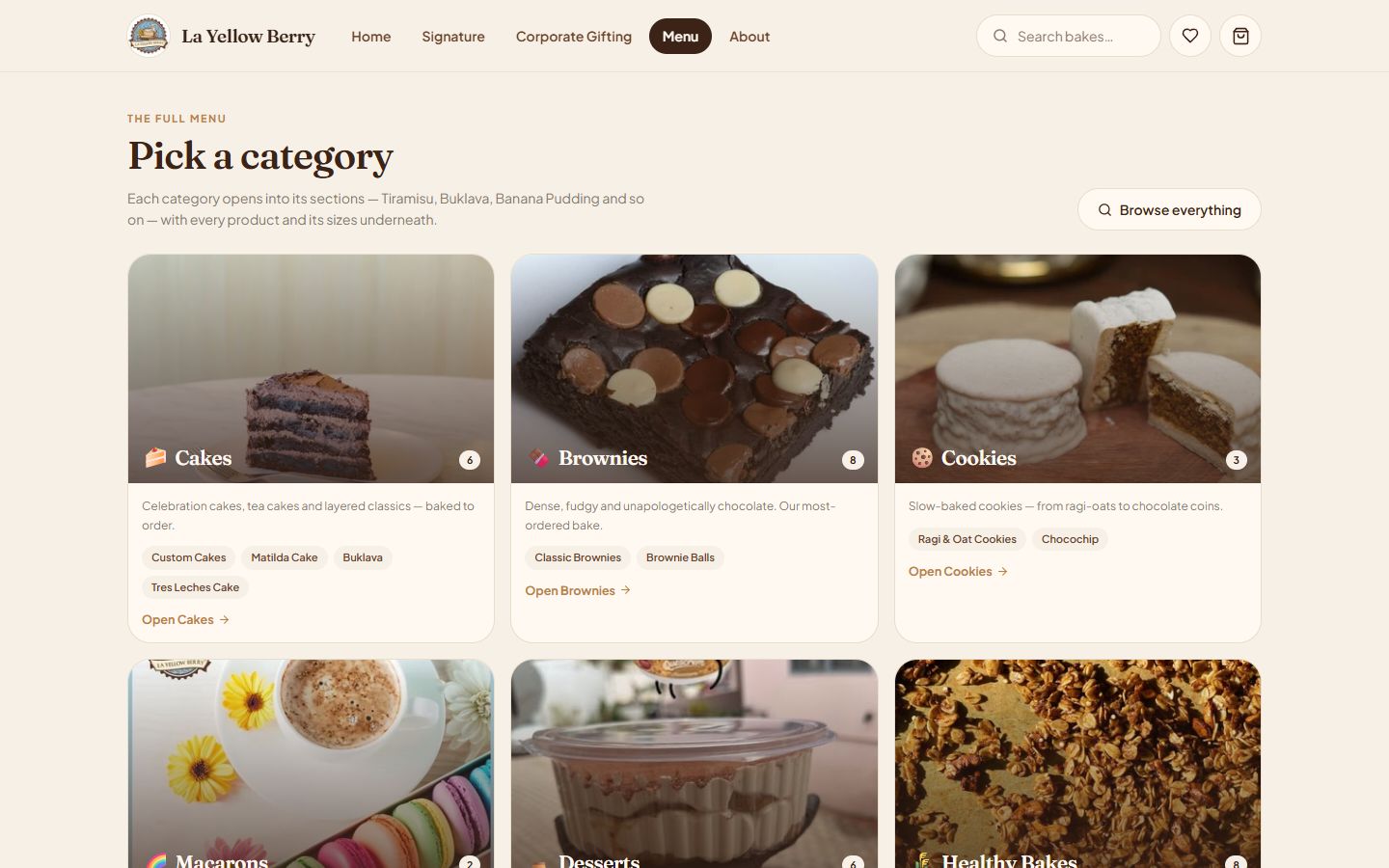
Screens captured from the live catalogue app inside the brand's Shopify store.
Why a made-to-order bakery needs a different kind of cake shop website
A homemade bakery does not sell stock off a shelf. La Yellow Berry bakes or packs every order after it comes in, needs at least 24 hours' notice, prices custom cakes by weight, finish and add-ons, and quotes gift hampers one order at a time. A cake shop website built like a normal online shop — fixed price, in stock, pay now — does not fit that.
The range is wide for a home kitchen:
- Chocolates and mixes — date chocolates, a hazelnut chocolate mix, trail mixes, a makhana mix and granola.
- Bakes and desserts — brownies, cookies, macarons, tiramisu, banana puddings, buklava, tres leches, choco pies and a kunafa bread pudding.
- Healthy bakes — made with ragi, oats, jaggery, dates and honey instead of refined sugar. Across the range, the brand leans on premium ingredients such as Callebaut couverture.
- Celebration cakes — made to order, each with its own weight, flavour, finish, message and add-ons.
- Corporate and festive gifting — hampers for Diwali, New Year, weddings and client gifting, from a minimum of 10 hampers, with optional co-branding and volume pricing from 25 boxes.
Its customers fall into three groups: Surat households ordering cakes and desserts, health-conscious snackers, and businesses or families buying hampers in bulk. Each group needs something different from the website, and all three finish in the same place — WhatsApp, where the brand confirms availability and the final price.
The website's job is not to take payment. It is to turn a customer's choices into a complete, unambiguous order — the right size, the right message on the cake, a date the kitchen can meet — and hand it to the person who bakes it.
What was stopping a proper online menu for the bakery?
The full range existed offline and in pieces. The menu was a two-page printed card, the Shopify store showed four packaged products, product photos were spread across Instagram, a Swiggy storefront and WhatsApp chats, and the gifting range was a set of photos sent on WhatsApp. None of it let a customer build a cake order online.
- The menu was a printed card. Two pages, not searchable, with no link to a single cake or dessert and nothing to order from. The build kept it as the reference for how the menu should be organised and priced.
- The Shopify store showed four products. Dates chocolate, white dates chocolate, a hazelnut chocolate mix and an organic trail mix. None of the cakes, brownies, cookies, macarons, desserts or hampers were online there.
- Photos lived in three places. Instagram, the Swiggy storefront and WhatsApp messages each held part of the picture library.
- Hampers had no price to put on a product page. Every hamper is quoted per order, so a normal cart-and-price product page did not fit.
- A custom cake is six decisions, not one. Weight, flavour, finish, message, add-ons and a reference photo all change the price, and nothing online captured them or showed an estimate.
- Shopify has rules of its own. Shopify reserves the
/products/path for its own product pages and flattens theme files into a single assets folder, so a standalone app's screens and images could not simply be dropped onto the store's domain.
How ordering changed
Before
- Full menu on a two-page printed card
- 4 packaged products on the Shopify store
- Product photos spread across Instagram, Swiggy and WhatsApp
- Hampers existed only as photos in a WhatsApp chat
- No online form or estimate for a custom cake
- No online way to pick a date that respects the notice period
After
- 66 catalogue entries in 24 menu sections, searchable and linkable
- Catalogue app inside the same Shopify store, existing theme kept
- One picture library served from Shopify's CDN, sized per screen
- 23 hamper formats, each with its own page and WhatsApp brief
- Cake options chosen on one screen with an itemised live estimate
- A date picker that enforces the 24-hour notice
Why a Shopify catalogue app instead of rebuilding the store?
La Yellow Berry already had a Shopify store on its own domain, with its theme and packaged products in place. Rebuilding it would have put a working store at risk, and a separate website would have split the brand across two addresses. So Yukti AI built the catalogue as an app that lives on its own pages inside the same store and leaves the existing theme's design, products and checkout in place.
Standard Shopify product pages were the other option, but they assume a fixed price per variant, stock and Shopify's own checkout. This menu needed hampers with no price, cakes priced by six groups of options, a date that respects a notice period, and an order that ends in a chat. Each could be bolted onto a theme with apps; together, they made a purpose-built Shopify catalogue app the cleaner answer. Yukti AI took a similar route for Backdrop India, whose catalogue storefront also runs inside its existing Shopify store.
How does a React ordering app run inside a Shopify store?
The app is an ordinary React website compiled into one JavaScript file and one CSS file and uploaded to the store's theme assets. Two custom Shopify page templates load it on a blank page, so the theme's styles and scripts never touch it. Hash-based routes keep every screen under one Shopify page, and a generated Liquid map points every photo to Shopify's CDN.
Custom page templates with {% layout none %}
A Shopify page normally renders inside the theme. Starting a page template with {% layout none %} tells Shopify to output only what the template contains. La Yellow Berry's two templates, page.catalogue and page.menu, hold little more than a container for the app, its CSS and JavaScript, the image map and one setting for the opening screen. The theme's styles and scripts never load on these pages, so they cannot clash with the app's.
Hash routes, because Shopify owns the URLs
Shopify decides what lives at paths such as /products/. With a HashRouter, every screen sits after the # sign in the address, which Shopify never reads, so the whole app runs from one Shopify page and every category and product still has its own shareable link.
A generated Liquid image map for the photos
Shopify keeps theme files in one flat assets folder and serves them from its CDN at addresses it generates. A small Python script writes a Liquid snippet that maps every image path to its Shopify asset_url, and the app looks up that map whenever it shows a photo. When photos change, the script is simply re-run.
Fixed file names, so an update is an upload
The build always writes lyb-app.js and lyb-app.css under the same names, so the Shopify templates never need editing. A deploy is: build, copy the bundle and images into the theme assets (104 files), regenerate the image map, upload.
The customer sees one smooth app on the brand's own domain. Shopify sees two ordinary pages. The theme's design, the four packaged products and the store's own checkout stay as they were; the build only adds two page templates, one snippet and the app's asset files.
What Yukti AI built: the modules
The app has a mobile-first storefront, a three-level menu, product pages built for a bake-to-order kitchen, a data-driven customiser, a signature range, a gifting section, browse and search tools, and the WhatsApp checkout. Every product and option is data, so the menu can change without new code.
Mobile-first storefront with 12 screens
Home, Menu, Signature, Corporate Gifting, Explore, Category, Product, Cart, Checkout, Order Sent, Favourites and About. Home carries the brand's hero (“Sweet moments, handcrafted.”), a shop-by-category grid, a signature rail, a best-sellers rail that never repeats the signature products, a gifting banner and a three-promise strip: Made to order, Wholesome options, Surat delivery.
A product catalogue website that mirrors the printed menu
43 menu items in 8 categories — Cakes 6, Brownies 8, Cookies 3, Macarons 2, Desserts 6, Healthy Bakes 8, Premium Mixes 3, Chocolates 7 — plus 23 hampers in Corporate & Festive Gifting. They sit in 24 sections copied from the printed card, such as Classic Brownies, Ragi & Oat Cookies, Banana Pudding, Healthy Cakes, Trail Mixes and Choco Pie, with a Menu view / All toggle on each category. Products carry their sizes (for example a 250 gm tub, cup or mini cup, or a box of 6 or 12), tags, ingredients and allergens. Benefit: regular customers find items where the printed card taught them to look.
Product pages for a bake-to-order kitchen
Each item is labelled Preorder, not “In stock”. Hampers show “Price on request” and “Enquire on WhatsApp” instead of a cart button. A four-tile strip (Freshly baked, Health-conscious, Premium packaging, Hygienically packed), a storage note for each category and a “Good to know” FAQ built from data sit below the options; the cake-message question only appears where a message is offered.
Signature range, browse and search
A Signature screen shows 14 ready-made hero products, from Dates Chocolate and Trail Mix to Tiramisu Classic and Matilda Cake, kept apart from the cake flow. Filter sheets cover category, four price bands, tags and availability; sorting covers recommended, price, name and newest; and a full-screen search overlay (“Search bakes…”) is one tap away in the header. Favourites are saved in the customer's browser.
A data layer ready for a real backend
The screens read data only through a small service layer, and the data is shaped like database tables: categories, products, variants, option groups, options, orders and order items. Connecting a database such as Supabase later means rewriting two service files, not the screens. An owner view was also prototyped; every real order arrives in the brand's WhatsApp.
How the bakery online ordering system works, from menu to WhatsApp
A customer opens the menu from a link, picks a category, chooses a product and its options, adds it to the cart, fills in a short checkout and sends the order on WhatsApp. The brand then confirms availability and the final price in the chat. There is no account to create, no payment page and no app to install.
The custom celebration cake
The cake flow adds the choices a baker needs before the oven goes on. Each step is one group of options on the same product page, and the estimate is itemised as they are chosen.
How does a WhatsApp ordering website work without a payment gateway?
The checkout collects what the kitchen needs, then opens WhatsApp with the whole order already typed out to the brand's number, and the customer presses send. Because nothing is baked until the order is confirmed, the brand checks availability and the final price in the chat. That is why no payment gateway, customer account or login is needed.
Checkout asks for a name, a WhatsApp number (at least 10 digits), Delivery across Surat or Pickup from the kitchen, a date, an address (only for delivery) and optional notes. The date picker does not offer anything sooner than the notice period — 24 hours by default — so a customer cannot ask for a cake the kitchen cannot make. A “Preview the WhatsApp message” toggle shows the exact text before it is sent, and on phones a sticky “Send Order” button carries the running total.
| Part of the message | What it contains |
|---|---|
| Each item | Product name, chosen size, quantity and line estimate |
| Each option | Every choice made — flavour, finish, add-ons — with the cake message in quotes and any dates written out |
| Reference photo | Noted as “will share on chat”, so the customer sends the image straight after |
| Customer | Name and WhatsApp number |
| Fulfilment | Delivery or pickup, the date, and the address for a delivery |
| Total | The estimated total and the line “Please confirm availability and final price.” |
After sending, the cart clears and an Order Sent screen shows the customer an order code. The customer's details are remembered in their browser for next time, and separate pre-filled links handle general questions, single-product questions and gifting briefs.
The hand-off uses a WhatsApp click-to-chat (wa.me) link, which works with the brand's existing WhatsApp and needs no API approval or per-message charges. If a bakery later wants automatic replies, order-status messages or a chatbot that answers menu questions, Yukti AI builds those as a separate layer — see WhatsApp automation and the WhatsApp AI chatbot.
A custom cake order form with a live price estimate
The Signature Celebration Cake page works as a full custom cake order form: weight, flavour, finish, a message, add-ons and a reference photo, with the estimate recalculated and itemised at every tap. It is not hand-coded for that one cake. A single customisation engine reads each product's options from data, so any product can be given options without new code.
- Weight — 0.5, 1, 1.5 or 2 kg.
- Flavour — Belgian Chocolate, Vanilla Bean, Red Velvet, Butterscotch or Coffee Hazelnut.
- Finish & style — Classic, Premium, Photo Cake or Theme Cake.
- Message on cake — up to 25 characters, piped by hand.
- Add-ons — Name Topper, Photo Print, Extra Decoration, Candles & Knife.
- Reference image — the customer attaches a photo of the design they want, and the order message tells the brand it will follow in the chat.
How the customisation engine works
There are five option types — single choice, multiple choice, free text, date and image upload — and each option can carry a price adjustment. The live price is the size price plus the adjustments, shown as a breakdown rather than one unexplained number. Required choices are checked before the cake goes into the cart, a required single choice always starts with an option selected, and tapping a selected optional choice clears it. The same cake with two different messages becomes two separate cart lines, so nothing is merged by mistake.
Nine presets are reused across the menu, from cake weight and flavour to macaron flavours (pick up to six), choco pie flavour and gift wrap (a gift box and ribbon, or a handwritten note).
When the brand adds a cake or changes a flavour list, it is a data edit and a re-upload, not a development job. The options, the validation and the estimate all follow from the data.
How do you sell gift hampers that are quoted per order?
Each hamper got its own product page, with its own name, description and unit, but no price. “Price on request” and an “Enquire on WhatsApp” button replace the cart, and the enquiry opens with a short brief already laid out: number of hampers, budget per hamper, needed-by date, delivery city and whether co-branding is wanted. The brand then builds a curated hamper and sends a sample photo and a firm quote for approval.
The first version modelled the gifting range as five products with several photos each, which made it look five times smaller than it is. Every photo was in fact a different hamper, so the range was rebuilt as 23 separate hamper formats in four groups: Premium Boxes, Baskets & Trays, Festive & Diwali, and Bulk & Event Orders. Examples include a Two-Tier Dry Fruit Tray, a Sage Bonbon Box, a Diwali Heritage Box, an Illuminated Diya Thali, an Organza Tray Saffron & Gold and a Marigold Jute Crate, each with a unit such as “quoted per box · bulk”.
The Corporate Gifting page
It states the terms up front — a minimum of 10 hampers and volume pricing from 25 boxes — then shows three value cards (100% homemade, Co-branding, Plan ahead), three indicative hamper tiers (Classic, Signature and Bespoke) with what each includes, a grid of every hamper format, and a four-step “How it works”: tell us the brief, we build the hamper, you approve a sample photo and a firm quote, we deliver across Surat.
Healthy bakes: product pages whose claims match the recipe
La Yellow Berry sells health as much as taste, so its product pages needed claims customers can trust. The proof chips and highlight cards on each page — No refined sugar, Jaggery sweetened, Millet based, Callebaut couverture, Date sweetened, Honey sweetened — are generated from that product's own tags and ingredients. A page cannot show a claim its recipe does not support.
The same care applies to the kitchen's promises. Every product is labelled Preorder, the checkout enforces 24 hours' notice, and a “same-day delivery” tile from an early version was replaced with the health promise because it contradicted the notice period. Claims the client did not want to make were removed on request. Ingredients and allergens sit on every product, and each category carries its own storage note.
Built for the phone, with one link for Instagram and QR codes
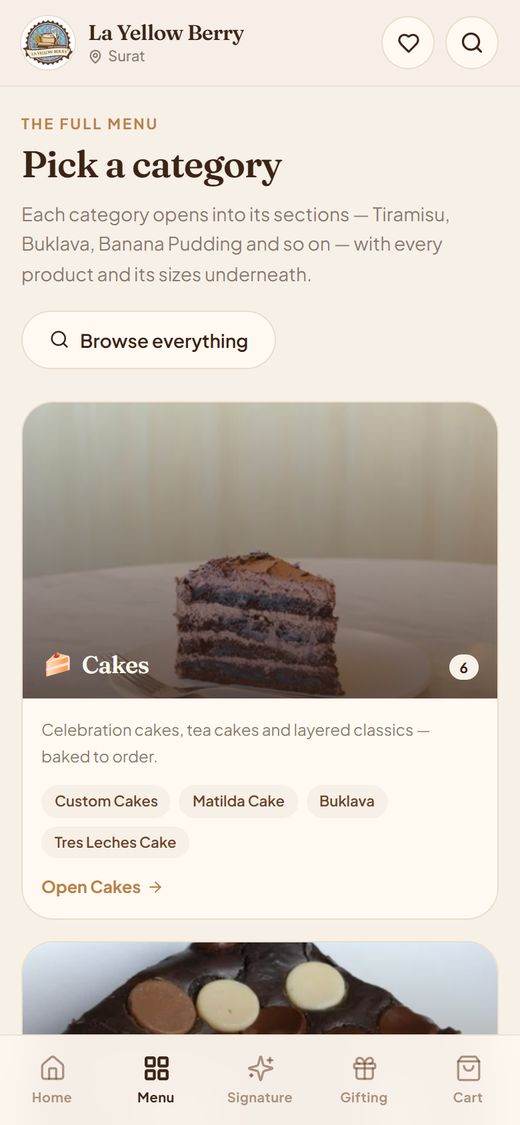
The brand sells through Instagram and WhatsApp, where customers are on their phones, so every screen was laid out for a phone first. Home, Menu, Signature, Gifting and Cart sit in a bottom tab bar, filters and sorting slide up as bottom sheets, and the order total stays visible on a sticky Send Order button at checkout. On a laptop the tab bar becomes a top navigation bar and the order summary stays sticky.
Two entry points share one app. /pages/catalogue opens on Home for anyone arriving at the full storefront. /pages/menu opens straight on the Menu, meant for an Instagram bio link, a QR code or a WhatsApp bio, where the customer wants the menu rather than the brand story. Because both are ordinary Shopify pages on layellowberry.com, a printed QR code or a saved bio link keeps working after every app update.
Option chips also announce their state to screen readers, and in-page scrolling respects the phone's reduced-motion setting.
Will a bakery website with lots of photos load fast?
It will if every photo is sent at the size it is shown. The app asks Shopify's CDN for each image at the width of the tile it fills, with a srcset so phones and laptops each get what they need. Before this fix the gifting category pulled 7.8 MB, because 1,600-pixel photos were being shown in 219-pixel tiles; a sample of ten cards dropped from 1,875 KB to 293 KB.
Every image in the app declares its real display size, and logos request 96 pixels instead of the full file. Product photography was gathered from Instagram, the Swiggy storefront and 54 media files the client sent on WhatsApp. In all, the app carries 89 product images, 9 Instagram tiles and 4 brand images, served from the store's theme assets through Shopify's CDN.
What each customer group gets
Households ordering cakes and desserts
The menu in the order of the printed card, a custom cake order form with a live estimate, and a date picker that respects the notice period.
Health-conscious snackers
Healthy Bakes and Premium Mixes as their own categories, proof chips generated from ingredients, and allergens on every product.
Corporate and bulk gifting buyers
23 hamper formats, the minimum and volume terms stated up front, and a one-tap WhatsApp brief with the details the brand needs to quote.
The brand
Complete, pre-written orders in its own WhatsApp that already respect the notice period, and a catalogue that changes through data rather than redesign.
How it was built in about 7 days
The catalogue was built in about 7 days and then refined through a quick revision loop driven by the brand's WhatsApp feedback. The work ran in five steps, from the printed menu card to a live app inside the Shopify store.
Gather the menu and photos
The printed menu card became the reference for categories, sections and sizes. Photos came from Instagram, the Swiggy storefront and 54 files the client sent on WhatsApp.
Model the catalogue
Categories, 24 menu sections, variants, tags, ingredients, allergens and nine reusable option presets — all as data, with no product hard-coded.
Build the app
React, TypeScript, Vite and Tailwind, mobile-first: storefront, product pages, customiser, gifting section and the WhatsApp checkout.
Embed it in Shopify
Two {% layout none %} page templates, fixed bundle names, the generated Liquid image map, and the assets uploaded to the theme.
Revise from WhatsApp feedback
The client sent photos, captions and annotated screenshots of the live catalogue; one launch commit was followed by ten revision commits.
The catalogue launched with 42 products in 8 categories. Revisions then added the enquiry-only gifting category, Preorder labels, a kunafa pudding, repricing, the service strip and product FAQ, and the health promise in place of a same-day delivery tile. The live app now carries 66 entries across 9 categories.
What is now online
Counts taken from the live build — not sales, order or traffic figures.
Technology and integrations
The catalogue is a React 18 and TypeScript app built with Vite and styled with Tailwind CSS, running on two Shopify page templates. It has no server of its own: product data ships with the app, photos come from Shopify's CDN, and orders go out through WhatsApp click-to-chat.
Integrations: WhatsApp click-to-chat links for orders, product questions, general enquiries and gifting briefs; the Shopify storefront and its CDN; a Google Maps “Get directions” link and a call link on the About page; and an Instagram tile strip. The data layer is designed for a later Supabase backend, which is not connected today.
Full technical stack
- React 18.3 + TypeScript 5.6 — storefront, product pages, customiser and checkout.
- Vite 5.4 — fixed output names (
lyb-app.js,lyb-app.css) for Shopify. - Tailwind CSS 3.4 — a cocoa, cream and gold design with Fraunces and Plus Jakarta Sans.
- React Router 6 (HashRouter) — every screen under one Shopify page.
- Shopify Liquid + CDN — two
{% layout none %}templates, a generated image-map snippet, responsive images. - Python — regenerates the Liquid image map.
- Browser storage and lucide-react — cart, favourites and saved details; icons.
How much does a bakery website with online ordering cost?
Shopify store and catalogue projects at Yukti AI start from ₹60,000. The fixed quote depends on the size of your menu, how many products need options such as a cake builder, whether you sell enquiry-only items like hampers, whether the catalogue goes inside an existing Shopify store or a new one, and integrations. La Yellow Berry's build took about 7 days.
| What moves the quote | Why |
|---|---|
| Menu size and structure | The number of categories, sections, products and sizes to model |
| Customisation | How many products need options, and how many option types and add-ons |
| Enquiry-only lines | Hampers, bulk or event orders that are quoted per order |
| Where it lives | Inside an existing Shopify store, in a new Shopify store, or as a standalone website |
| Ordering | A WhatsApp hand-off only, or online payment and delivery integrations as well |
| Photos and content | Collecting, cleaning and sizing images from Instagram, WhatsApp and delivery-app listings |
| After the order | Automatic WhatsApp replies, order-status messages or an order back office |
It is a one-time build with a fixed quote, agreed after a free workflow audit. Shopify's own plan and any Shopify apps are paid by the business directly to Shopify. See Shopify Store Development for the full service.
Is this right for your homemade food business website?
It fits any food business that bakes or cooks to order and confirms orders personally: home bakers, cake shops, chocolatiers, dessert makers, and dry-fruit and gifting brands. If you already have a Shopify store, the catalogue can sit inside it, as La Yellow Berry's does; if you do not, Yukti AI can build the store or a standalone catalogue website.
Yukti AI is a software company based in Varachha, Surat, and works with businesses across Surat and India. Other Surat builds include Backdrop India, an app-style catalogue storefront inside Shopify alongside a multi-marketplace inventory system, and Lumera Fine Jewellery's custom jewellery ERP and CRM. For web apps outside Shopify, see App & Web App Development; for shops and D2C brands, see Retail & E-commerce. For complete custom Shopify stores rather than a catalogue inside one, see the Shinelabb and Miswah Jewellery case studies.
Questions bakeries and food brands ask
Explore more
Shopify Store Development
Custom Shopify themes, catalogue apps inside Shopify and integrations.
Case study: Backdrop India
Another catalogue storefront inside Shopify, with multi-marketplace inventory.
Case study: Shinelabb
A custom Shopify store for lab-grown diamond jewellery.
Case study: Miswah Jewellery
A custom Shopify jewellery theme, shopped by material and shape.
WhatsApp AI Chatbot
An AI assistant that answers menu and order questions on WhatsApp.
WhatsApp Automation
Automatic replies, follow-ups and order-status messages.
App & Web App Development
Custom web apps and catalogue websites outside Shopify.
Retail & E-commerce
Catalogues, ordering and stock for shops and D2C brands.
All case studies
Every Yukti AI build: Shopify, catalogues, ERP, CRM and automation.
Summary
- Yukti AI, a software company in Surat, built a mobile-first bakery catalogue and online ordering app for La Yellow Berry, a homemade bakery and chocolate brand in Surat, Gujarat.
- The La Yellow Berry catalogue built by Yukti AI runs inside the brand's existing Shopify store at layellowberry.com, on /pages/catalogue and /pages/menu, using two custom page templates with {% layout none %}, a HashRouter and a generated Liquid image map, so the store's existing theme did not have to be replaced.
- Yukti AI turned La Yellow Berry's two-page printed menu card into a live catalogue of 66 entries across 9 categories and 24 menu sections, with sizes, ingredients, allergens, search and filters.
- The checkout Yukti AI built for La Yellow Berry sends the complete order — sizes, options, cake message, reference photo note, delivery or pickup date and estimated total — to the brand on WhatsApp, with no payment gateway and no customer login.
- Yukti AI built a data-driven custom cake order form with an itemised live estimate for La Yellow Berry, and listed 23 corporate and festive gift hampers as enquiry-only products with a structured WhatsApp brief.
- Yukti AI built the La Yellow Berry Shopify catalogue app in about 7 days; Shopify store and catalogue projects at Yukti AI start from ₹60,000.